
Engineered wood flooring
Compare construction, wear-layer information, site conditions, and the transition plan before selecting a product.
Questions to resolve
Choose for the conditions, not only the color.
- Is the floor over concrete? Check the selected product's approved installation method and moisture requirements. Choosing engineered wood does not remove the need to assess the slab.
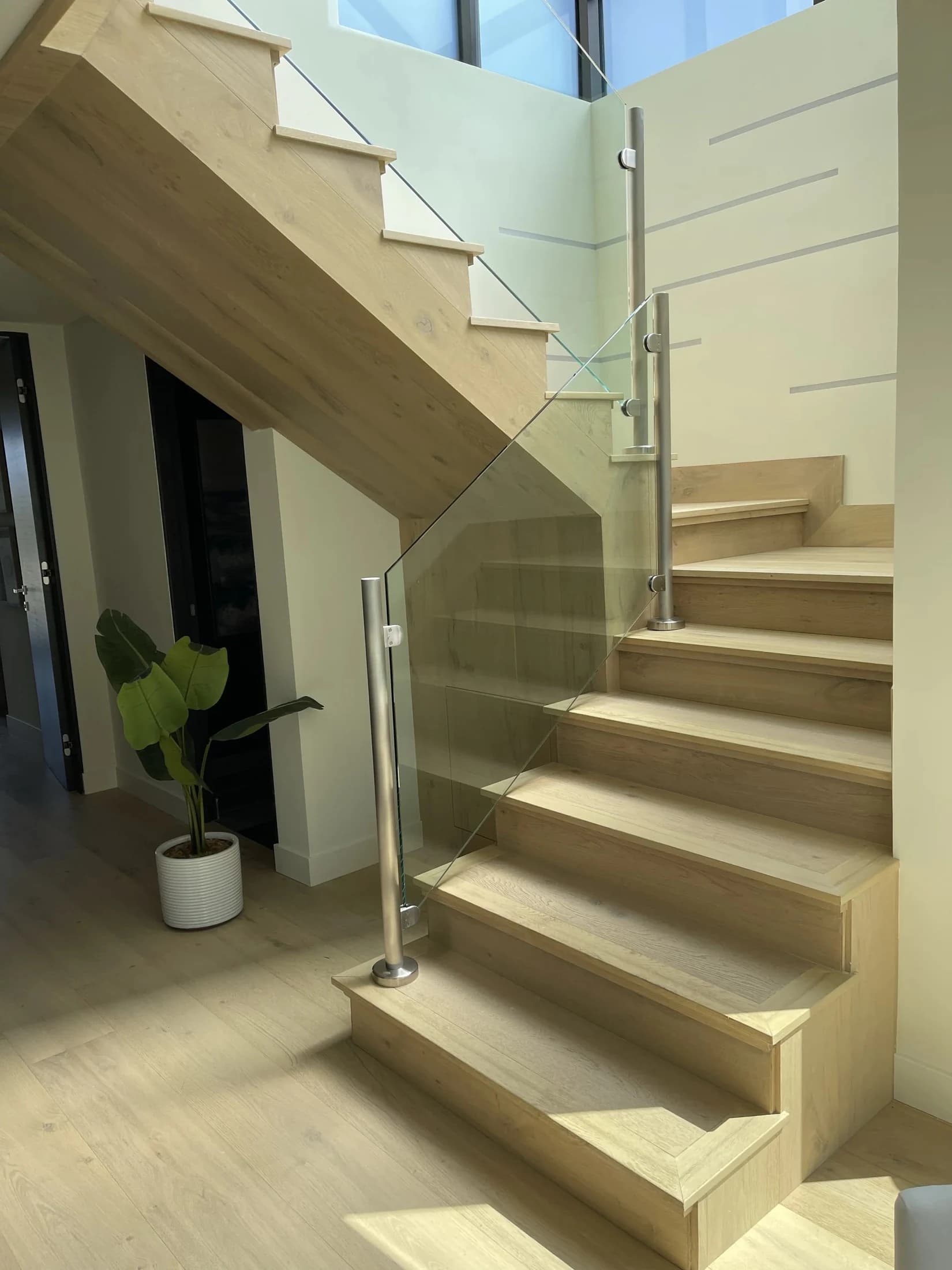
- Will the new floor meet existing rooms and stairs? Compare the complete assembly height, including preparation and underlayment where required, rather than plank thickness alone.
- Can this product be refinished? Review its wear-layer information and manufacturer guidance. Do not assume every engineered floor can be sanded, or that a fixed number of future refinishes is guaranteed.
Manufacturer, collection, dimensions, availability, and price are confirmed only from current product documentation and a project-specific conversation.
The short answer
Engineered wood installs in San Diego for about $8 to $18 per square foot, material and labor, a market range from 2026 Southern California guides, not a Swell price. A wood top layer bonded to a plywood or fiber core lets the plank glue or float over a concrete slab. Whether it can be refinished depends on the wear layer.
- Installed market range
- About $8 to $18 per sq ft (Southern California and Los Angeles guides, 2026); confirmed in your written estimate
- Removal and prep
- Old floor removal $1.50 to $5 per sq ft; slab leveling or repair $2 to $5 per sq ft (San Diego market guides, 2026)
- Best for
- Slab-on-grade homes, ADUs and garage conversions, condos with HOA sound rules, and rooms with radiant heat where the manufacturer approves it
- Watch out for
- Thin wear layers that cannot be sanded, damp slabs without moisture mitigation, and floating floors in very large open rooms
- Refinish later
- Depends on the wear layer: thick veneers can be sanded a limited number of times, thin ones only recoated or replaced
- Next step
- Free in-home measurement by Tidal Flooring, CSLB C-15 #1002910, before any written price
What engineered wood is and how it is built
An engineered plank is a sandwich. The top is a layer of real hardwood, called the wear layer or veneer, which is what you see and walk on. Under it are several layers of plywood or a dense fiber core laid with the grain running in alternating directions. That cross construction is what makes the plank stable where a solid board would cup or gap.
The wear layer is the number to ask about, because it decides whether the floor can ever be sanded. A thick veneer behaves much like solid wood for refinishing; a thin one cannot be sanded at all, and a worn board is replaced. Two products with the same catalog photo can differ here completely, which is why the product sheet travels with the sample.
Where it works in San Diego homes
Engineered wood is the wood floor for most San Diego homes built after the 1960s, because most of them sit on a concrete slab. The plank glues down with a flooring adhesive or floats on an underlayment directly over the slab, with no built-up subfloor. The same applies to ADUs and garage conversions, where the slab is the floor and every inch of height matters at the door thresholds.
Condos are where engineered wood earns its place. HOAs in La Jolla, Downtown, Coronado and Carlsbad commonly require a minimum impact sound rating for any hard floor over a neighbor and an approval letter before work starts. A floated or glued engineered floor over an acoustic underlayment with a tested rating is the standard way to meet that rule. We ask for the HOA's document before the measurement visit.
Coastal humidity suits engineered construction: the cross-layered core moves less with the seasons than solid wood, so wide planks in a Del Mar or Encinitas living room with open sliders stay flatter. In 1920s to 1950s homes on a raised foundation it can also be nailed to the wood subfloor, and the choice against solid comes down to refinishing plans and plank width.
What it costs in San Diego in 2026
Southern California and Los Angeles guides published in 2026 put engineered wood installed at about $8 to $18 per square foot, material and labor. This is a market range, not Swell's price; the product line, the wear layer thickness and the installation method move it. A thick-veneer European oak plank glued over a slab sits toward the top. A thinner-veneer floating floor sits toward the bottom.
Removal and prep are separate. San Diego guides put old floor removal at $1.50 to $5 per square foot and leveling or repair at $2 to $5 per square foot. Slabs that test damp need a moisture mitigation layer, which is a real cost that no sample can show you. Stairs and transitions are priced per piece. The written estimate after a measurement visit replaces every range on this page.
Installation methods and prep
Three methods, and the subfloor picks one. Glue-down bonds every plank to the slab or plywood with a flooring adhesive; it is the quietest and most solid underfoot. Floating locks the planks to each other over an underlayment with no fastening to the subfloor; it is faster and works over many existing floors, but needs expansion gaps and sometimes transition strips in large rooms. Nail or staple-down is for wood subfloors only.
Slab prep is where the job is won. The slab is tested for moisture and checked for flatness; high spots are ground and low spots filled so the planks do not rock or telegraph the dips. Where the slab tests damp, a mitigation membrane or a moisture-resistant adhesive goes down first. The planks acclimate per the manufacturer's instructions before installation.
Height is planned, not discovered: the full assembly is compared with adjoining tile, carpet and thresholds so doors swing and transitions sit flush. Radiant heat needs the manufacturer's written approval for the specific product.
Care, lifespan and the honest downsides
Care is the same as solid hardwood: grit off the floor, spills wiped promptly, felt pads under furniture, the cleaner the finish manufacturer names, and no steam mops. When the factory finish dulls, many engineered floors can take a screen and recoat, which Swell plans at $2 to $4 per square foot, as long as the original finish is compatible with a new coat.
The honest limit is the wear layer. A thin veneer cannot be sanded, so a deep scratch or a pet stain means replacing the board, and factory colors change over the years, which makes a perfect match harder. A thick veneer can take a full sand and refinish at $4 to $9 per square foot in Swell's planning range, but fewer times than a solid floor. Ask for the product's refinishing guidance in writing before you buy.
How Tidal Flooring installs it
Tidal Flooring, the flooring division of Swell Contracting, holds CSLB C-15 license #1002910. A free in-home measurement comes first, including the slab moisture check where the floor is concrete. Samples are compared in your rooms, in daylight and lamplight, beside your cabinets and trim, and the product sheet with the wear layer is part of that review.
The written scope lists prep, moisture mitigation if needed, material, the installation method and trim as separate lines, with the install dates and material lead times for your specific job. Call (619) 403-3662 or request a measurement to start.
Engineered wood flooring questions
Solid vs engineered hardwood: which is better for San Diego?
It depends on what is under the floor. On a concrete slab, which is most San Diego homes built after the 1960s and nearly every ADU, engineered wood glues or floats directly and solid cannot. On a raised foundation with a wood subfloor, either works; solid can be refinished more times, engineered stays flatter in wide planks near the coast. Condos with HOA sound rules almost always point to engineered.
Can engineered hardwood be refinished?
Only if the wear layer is thick enough, and then a limited number of times. Thin veneers cannot be sanded at all; the fix for a damaged board is replacement. Most engineered floors can take a screen and recoat when the finish dulls, as long as the new coat is compatible with the factory finish. Ask for the manufacturer's refinishing guidance in writing before ordering, and keep spare boards from the job.
How much does engineered wood flooring cost installed in San Diego?
About $8 to $18 per square foot installed, a 2026 market range from Southern California and Los Angeles guides and not a Swell price. Removal of the old floor adds $1.50 to $5 per square foot and slab leveling or repair $2 to $5 where needed, per San Diego guides. Moisture mitigation on a damp slab is an extra line. Your written estimate after a free measurement is the number that counts.
Engineered hardwood vs LVP: which should I choose?
Choose engineered wood when you want real wood underfoot, a floor that adds to resale, and a surface that can be recoated or, with a thick veneer, refinished. Choose luxury vinyl when the room sees standing water, hard daily wear from dogs and kids, or a rental budget, and when the fact that vinyl can never be refinished does not matter to you. Both go over a slab.
Can engineered wood go in a kitchen or over radiant heat?
Kitchens, yes, with the understanding that a leaking dishwasher or refrigerator line damages any wood floor; wipe spills and check the appliance connections. Radiant heat, only with the manufacturer's written approval for that exact product and the installation method, plus a controlled warm-up schedule after installation. Bathrooms and laundry rooms are better served by tile or vinyl.
Will the new floor sit level with the rooms next to it?
That is planned at the measurement visit, not discovered on install day. We measure the full assembly height, underlayment or adhesive plus plank, against the adjoining tile, carpet and door thresholds, and choose the method and transition pieces so doors clear and edges sit flush. Where the heights cannot meet, a reducer or T-molding is shown to you before the order.
Planning information, not a quote or an inventory list. Prices are set in a written estimate after a site visit. Last reviewed October 2026.
- GreatBuildz, flooring cost in Southern California (October 2026)
- Angi, new floor cost for Los Angeles, nearest metro with published data (2026)
- Precision Design and Remodel, kitchen remodel cost in San Diego, flooring line items (July 2026)
- Family Interiors, cost to install hardwood floors in San Diego (January 2026)
- King Remodeling, hardwood floor refinishing cost and process in San Diego (May 2026)
- CSLB, Check a License (verify C-15 #1002910 and B #970145)