
Luxury vinyl flooring
Review appearance, product documentation, subfloor preparation, and room-specific needs before ordering.
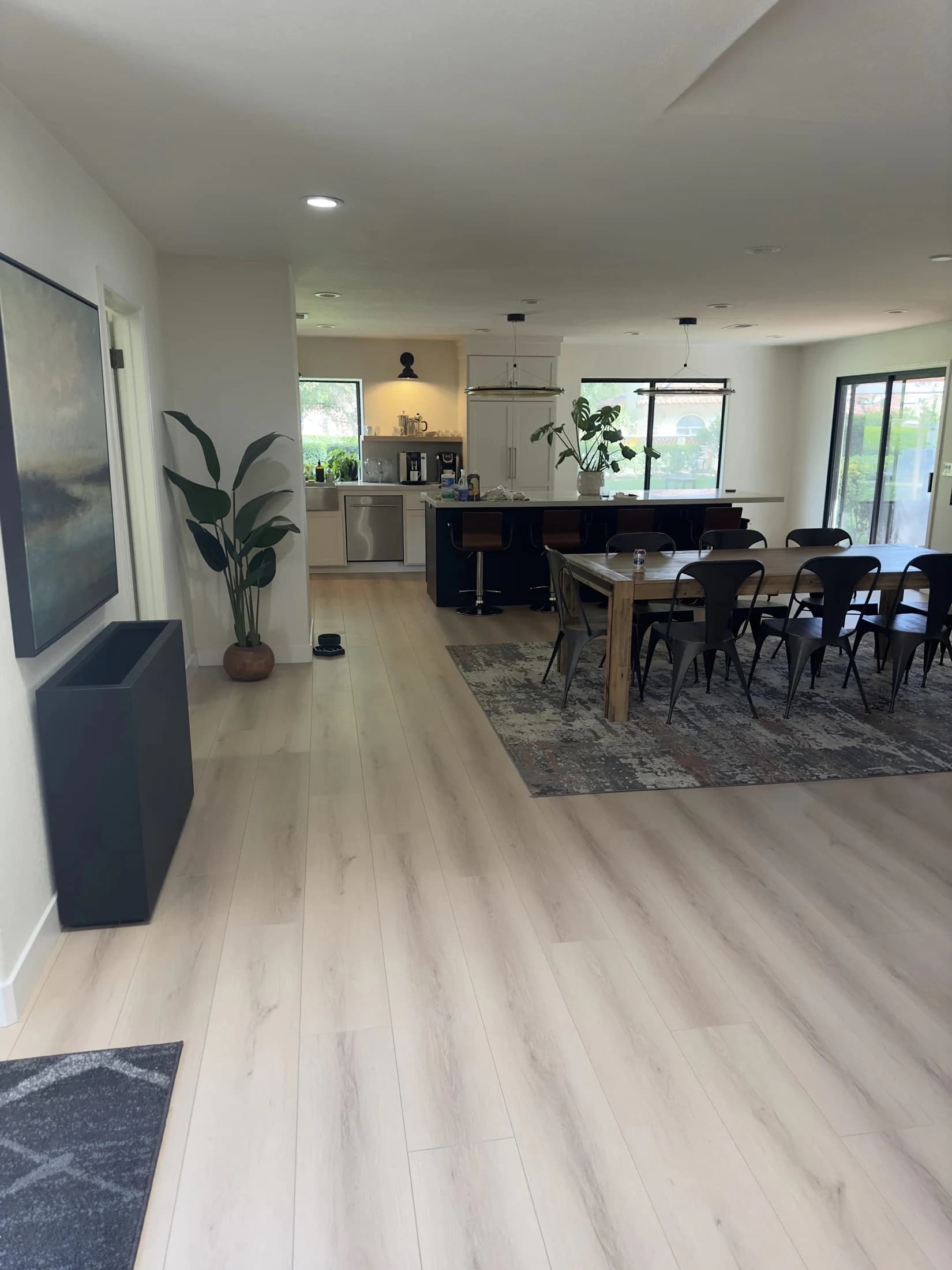
Questions to resolve
Choose for the conditions, not only the color.
- Where will the floor go? Tell us about pets, spills, direct sunlight, and adjoining rooms so the selected product's use and care instructions can be checked against daily life in your home.
- What preparation is required? Read the product's instructions for substrate condition, moisture, and installation method. A new surface should not hide a preparation problem that still needs attention.
- How will edges and stairs look? Confirm matching trim, stair details, and transitions before ordering. A sample shows the surface, but it does not settle the whole-room installation plan.
Manufacturer, collection, dimensions, availability, and price are confirmed only from current product documentation and a project-specific conversation.
The short answer
Luxury vinyl plank installs in San Diego for about $5 to $12 per square foot, material and labor, a 2026 market range from local and national guides, not a Swell price. It is a layered vinyl plank with a printed wood or stone image under a clear wear layer. Most products shrug off surface water. None can be refinished.
- Installed market range
- About $5 to $12 per sq ft (San Diego and national guides, 2025 to 2026); confirmed in your written estimate
- Removal and prep
- Old floor removal $1.50 to $5 per sq ft; subfloor leveling or repair $2 to $5 per sq ft (San Diego market guides, 2026)
- Best for
- Kitchens, laundry rooms, baths, rentals and turnovers, ADUs, and any slab home with dogs, kids or a tight budget
- Watch out for
- Uneven subfloors that telegraph through, direct sun through sliders, and the word waterproof, which covers the plank, not the subfloor
- Refinish later
- No. Damaged planks are replaced; keep a box of spares from the job
- Next step
- Free in-home measurement by Tidal Flooring, CSLB C-15 #1002910, before any written price
What luxury vinyl is and how it is built
Luxury vinyl plank, or LVP, is a layered synthetic floor. A printed film carries the wood or stone image, a clear wear layer protects it, and a core gives the plank its stiffness. Rigid-core products use a stone-polymer or wood-polymer composite core and click together to float over the subfloor. Flexible glue-down planks are thinner and bond to the subfloor with adhesive.
The wear layer is the spec that matters for durability. It is measured in mils, and a thicker wear layer resists scratches and scuffs longer. The image quality and the embossing, which gives the surface a wood-like texture, decide whether the floor reads as vinyl from across the room. Tile-look planks and sheets also exist for baths.
Where it works in San Diego homes
LVP floats or glues directly over a concrete slab, which makes it a practical floor for the slab-on-grade tract homes, ADUs and garage conversions that make up most of San Diego County. Kitchens, laundry rooms, hall baths and mudrooms are its natural rooms, because surface spills and pet accidents wipe up without harm.
Rentals and turnovers in Pacific Beach, Mira Mesa, Chula Vista and the city lean on LVP for the same reasons: it tolerates hard use, individual planks can be replaced, and a unit can be turned without waiting on a finish to cure. Property teams can read the trade page for install-only and supply-and-install options.
Two San Diego conditions need care. Direct sun through large south- and west-facing sliders heats the floor every afternoon; some products discolor or expand under that load, so the manufacturer's sun exposure guidance and expansion gaps matter in coastal and canyon homes. And in upper-floor condos, HOA sound rules apply to LVP as much as to wood; an attached pad or a separate acoustic underlayment with a tested rating is usually required.
What it costs in San Diego in 2026
San Diego remodel guides published in 2026 and a national cost guide updated in 2025 put LVP installed at about $5 to $12 per square foot, material and labor. This is a market range, not Swell's price. Rigid-core planks with thicker wear layers and attached pads sit toward the top; thin glue-down planks toward the bottom. Los Angeles guides stretch the band to about $4 to $14.
Removal and prep are separate lines. San Diego guides put old floor removal at $1.50 to $5 per square foot and leveling or repair at $2 to $5 per square foot. Because LVP is thin and flexible, flatness matters more than with wood: dips and ridges in the slab show through as waves, so leveling is often the biggest line after the material itself. Stairs need matching nosings, priced per step. Your written estimate after a free measurement is the number to plan on.
Installation methods and prep
Floating click-lock planks are the most common install. They lock to each other over an underlayment or an attached pad and are not fastened to the subfloor, so the floor needs an expansion gap at every wall and fixed object and, in very long or wide rooms, a transition strip where the manufacturer requires one. Glue-down planks bond to the subfloor with a pressure-sensitive adhesive and have no gap requirement, which suits open plans and heavy rolling loads.
Prep is the job. The slab or plywood is cleaned, high spots ground, low spots filled, and the surface checked for flatness to the manufacturer's tolerance. Slab moisture is tested; many rigid-core products tolerate moisture better than wood, but adhesives and pads have their own limits. Existing tile can sometimes stay if it is sound and flat, with the grout lines skimmed.
Care, lifespan and the honest downsides
Care is light: sweep, vacuum without a beater bar, damp mop with a neutral cleaner, felt pads under furniture, and a mat at exterior doors to keep grit off. Rubber-backed mats and some rubber feet can stain vinyl, so use the pad type the manufacturer names.
The downsides are worth saying plainly. LVP cannot be refinished; a deep gouge or a burn means replacing the plank, which is easy on a floating floor if you kept spares and harder on glue-down. Waterproof on the box means the plank itself does not absorb water. Water that gets through the seams or around the edges still reaches the subfloor, and a flood still means pulling the floor to dry what is under it.
Vinyl also feels and sounds different from wood and is valued differently by buyers and appraisers. For a home you plan to keep for decades, compare it against engineered wood before deciding on price alone.
How Tidal Flooring installs it
Tidal Flooring, the flooring division of Swell Contracting, holds CSLB C-15 license #1002910. We measure first, test the slab where there is one, and bring samples to your rooms so you can judge the image and texture in your own daylight next to your cabinets. The product's wear layer, sun guidance and warranty document are part of that review.
The written scope separates removal, leveling, material, underlayment or adhesive, installation, trim and stairs, with the install dates and material lead times for your job. Call (619) 403-3662 or request a measurement to start.
Luxury vinyl flooring questions
How much does LVP flooring cost installed in San Diego?
About $5 to $12 per square foot installed, material and labor, a 2026 market range from San Diego remodel guides and a national cost guide, not a Swell price. Removal of the old floor adds $1.50 to $5 per square foot and leveling $2 to $5 where the slab is uneven, per San Diego guides. Your written estimate after a free measurement is the number to plan on.
Is luxury vinyl plank waterproof?
The plank is, in most rigid-core products: it does not absorb water or swell the way wood does. The floor system is not. Water that passes through the seams or around the perimeter reaches the subfloor, and a flood or a long slow leak still means lifting planks to dry the slab or plywood underneath. Treat it as water resistant at the surface and plan the plumbing accordingly.
Can LVP be refinished or repaired?
It cannot be refinished. The surface is a printed image under a clear wear layer, so there is nothing to sand or restain. Repairs are by replacement: a floating floor lets us unlock planks back to the damaged one and swap it; a glue-down plank is cut out and a new one bonded in. Keep at least one unopened box from your job so the color and lot match.
Hardwood vs LVP for dogs and kids: which scratches less?
LVP with a thick wear layer resists scratches and pet accidents better than any wood finish, and a ruined plank is replaced rather than refinished. Hardwood shows nail marks on softer species and glossier finishes, but it can be screened and recoated or fully sanded when the damage adds up. If you want wood with pets, choose oak or hickory with a matte finish and keep nails trimmed.
Can LVP be installed over existing tile?
Often, yes, if the tile is sound, well bonded and flat. Grout lines and any lippage are skimmed with a leveling compound so they do not telegraph through the thin plank, and the added height is checked against doors and adjoining floors. Cracked, loose or badly uneven tile comes out first. The measurement visit settles it room by room.
Is LVP a good choice for a rental or a turnover?
Yes, for most units. It installs over a slab without a cure period, tolerates hard use and spills, lets you replace single planks between tenants, and keeps the per-square-foot cost near the low end of hard-surface floors. Property teams can arrange install-only labor or supply and install through the trade page; terms are set in a written agreement.
Planning information, not a quote or an inventory list. Prices are set in a written estimate after a site visit. Last reviewed October 2026.
- King Remodeling, kitchen remodel cost in San Diego, flooring line items (May 2026)
- GreatBuildz, flooring cost in Southern California (October 2026)
- Precision Design and Remodel, kitchen remodel cost in San Diego, flooring line items (July 2026)
- Fixr, luxury vinyl plank flooring cost, national (updated January 2025)
- Angi, new floor cost for Los Angeles, nearest metro with published data (2026)
- Family Interiors, cost to install hardwood floors in San Diego (January 2026)
- CSLB, Check a License (verify C-15 #1002910 and B #970145)